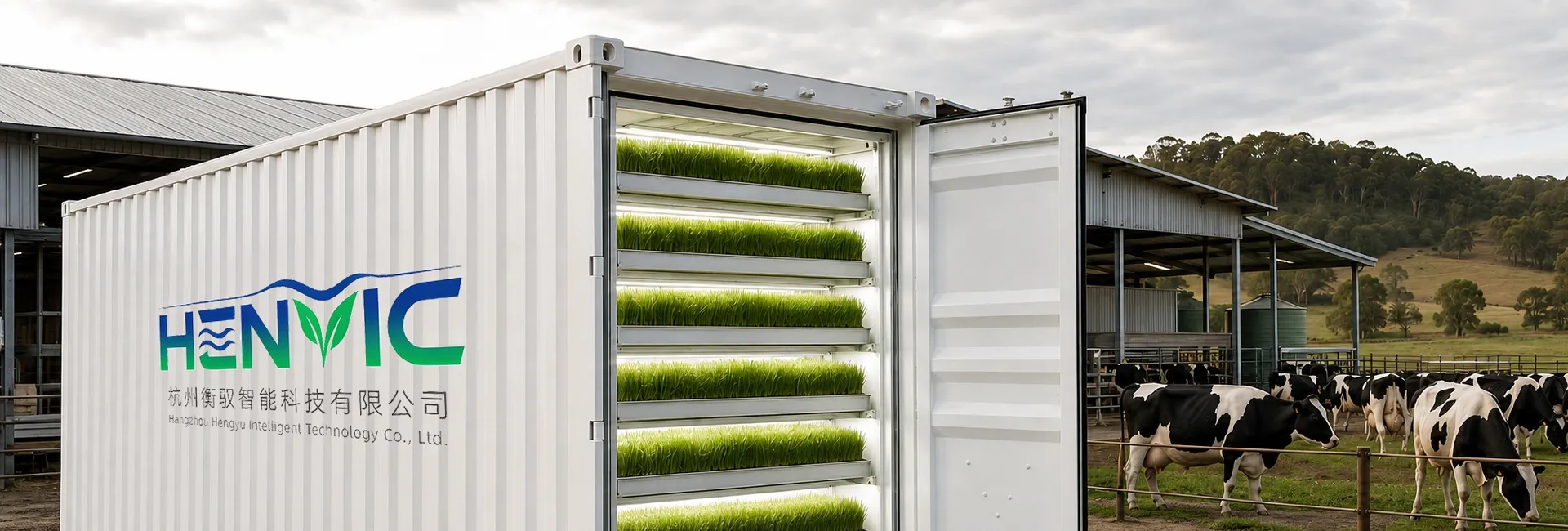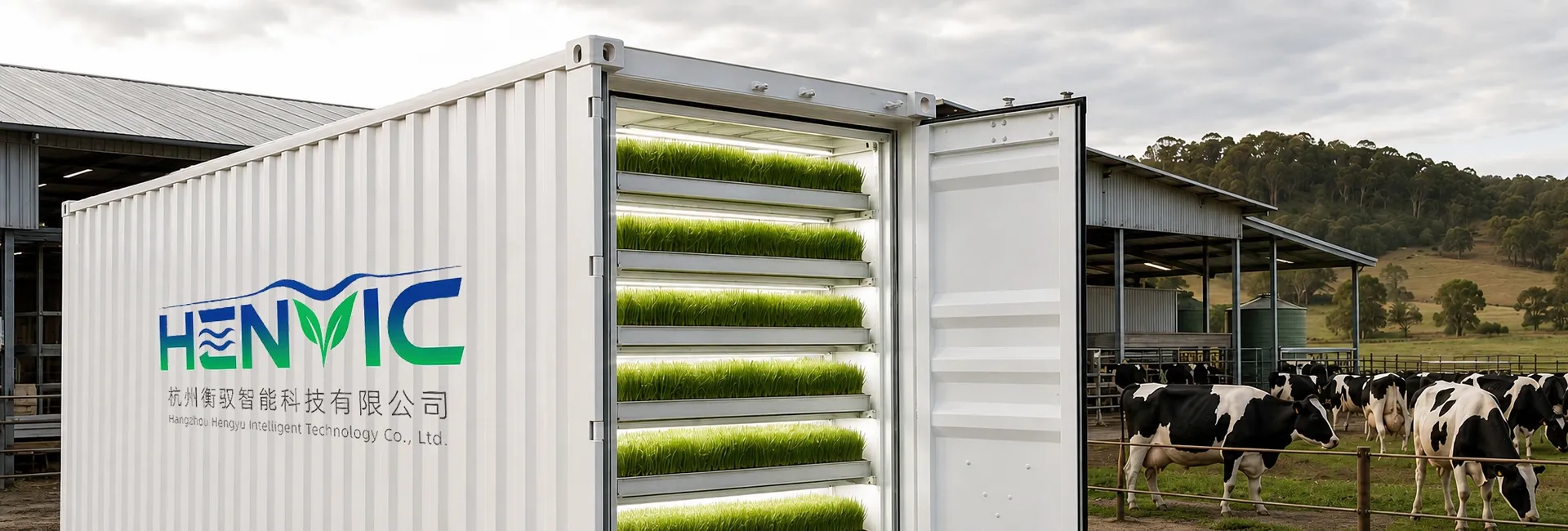
Every lettuce leaf in a city arrives at the end of a cold chain. It is cut somewhere, cooled, packed, trucked, re-cooled, displayed, and then — often — thrown away, because the last link in that chain is the most expensive and the least forgiving. The container farm's promise is not that it grows vegetables. It is that it deletes the chain. Harvest happens in the neighbourhood, the truck disappears, and the distance between a root and a plate collapses from a thousand kilometres to a few hundred metres. The question worth asking, years into the experiment, is not whether the technology works. It is how far that promise is from a business that scales.
What the Box Has Already Proved
The most rigorous public evidence comes from China, and it is worth stating precisely because the sector is full of claims that are not.
In December 2024, the 2024 Bright Food–Duoduo Vertical Farming Challenge closed on Chongming Island in Shanghai. Sixteen teams entered the fourth edition of the "Duoduo Agri-Tech Competition"; six reached the final, working in shipping containers over more than 160 days. The champion, China Agricultural University's Cyber Farmer team, reached a cultivation-area productivity of 0.33 kilograms of lettuce per square metre per day while holding electricity consumption to 12.25 kilowatt-hours per kilogram of lettuce — a figure the judges called industry-leading. Team leader Yang Hao said the effort centred on energy, using multi-source efficiency measures including cold-source integration and condensate recovery. Compared with the previous edition, the team more than doubled cultivation area and raised output nearly sixfold, while the share of energy consumed by air conditioning fell by nearly 70 percentage points.
The Shanghai Academy of Agricultural Sciences team attacked space instead. Team leader Miao Chen described a hanging, movable cultivation rack designed to lift the container's spatial efficiency, combined with extensive light trials to find a low-energy recipe for lettuce. In roughly fifty days the team harvested 1,680 heads weighing 299.55 kilograms from about 42 cubic metres, with more than ninety percent meeting Grade A commercial standards — the highest yield in the field.
Industry teams matched them on execution. Shandong's Leaf Heroes paired environmental linear control with deliberate ventilation so that a sealed box could still have a sunset and a breeze, harvesting heads averaging above 300 grams and one at 460 grams. Green Leaf Vanguard, the only finalist to remove the operator cabin, achieved a cultivation area 2.8 times that of field planting on the same footprint.
Read together, these results settle a question that was open a decade ago. Agronomy is no longer the constraint. A container can be made to produce clean, consistent, high-grade greens on a schedule the weather cannot touch. What has not been settled is everything that comes after the harvest.
The Gap Is Economic, Not Horticultural
He Dongxian, a professor at China Agricultural University and a judge at the competition, put the position plainly: several teams have reached internationally leading levels on yield and energy consumption and possess the capability for industrialisation, and with stable technology the model can reach profitability at scale.
That is a carefully worded claim, and the qualifier carries the weight. "At scale" is doing a great deal of work, because the cost structure of a single box is unforgiving in a way that a field's is not.
Start with energy. A sealed container has no sun, so every photon is purchased. At 12.25 kilowatt-hours per kilogram and an industrial tariff of roughly eight to ten US cents, electricity alone costs about one dollar per kilogram of lettuce — before seed, tray, nutrient, labour, or depreciation. Field lettuce wholesales for well under that. A box cannot win a price contest on a commodity crop, and no operational discipline changes the physics.
Then add labour, which is the line item that kills small projects. A single unit yields a few tonnes a year — not enough volume to absorb a full-time wage, yet the daily work of seeding, transplanting, harvesting, cleaning and monitoring does not shrink with the box. This mismatch is the quiet reason so many installations underperform their business plans.
Then add capital. Unlike a field, where the second hectare costs less per unit than the first, a container farm's equipment costs scale almost linearly with tiers, because every added layer needs its own lights and its own share of cooling. There is very little economy of scale inside one box. Scale must come from replicating boxes — which means the sector's central engineering problem is not growing, it is standardisation.
The Graveyard Is Instructive
The last few years have supplied a hard lesson in what happens when capital outruns unit economics. AeroFarms and AppHarvest both filed for bankruptcy in 2023. Plenty Unlimited, once the most generously funded name in the industry, sought Chapter 11 protection in March 2025. The failures were rarely about whether plants would grow. They were about the cost of the facility per kilogram of output, the distance between promised yields and delivered ones, and the assumption that scale would eventually fix a margin that was negative at every smaller size.
The container format is, in one sense, a reaction to exactly that error. It is deliberately small, modular and cheap relative to a purpose-built vertical warehouse — a bet that many modest units near many customers beat one enormous facility far from them. That is a better bet. It is not, by itself, a solution, because modularity lowers the entry ticket without lowering the cost per kilogram.
Where Scale Is Actually Beginning
The movements that look durable share a common feature: they sell something other than kilograms of lettuce.
The first is crop mix. Microgreens, herbs, edible flowers and specialty salad leaves wholesale at multiples of lettuce prices on shorter cycles, while electricity cost per kilogram stays roughly constant. Raising revenue per kilogram is the only lever that works without new physics, and it explains why so many viable container operations are herb and microgreen businesses rather than lettuce factories.
The second is integration with a customer rather than a market. The Moquan team, a finalist at Chongming, is trialling chives with a local Shanghai restaurant, working with Middle Eastern partners on basil and arugula, and testing strawberries in Thailand. Leaf Heroes has deployed plant-factory models in Japan, South Korea, Aruba and Thailand. In each case, the buyer is paying for continuity, a specific cultivar, same-day harvest, or food safety — things a cold chain cannot reliably deliver. During the finals, potential partners came to watch and to look for container plant-factory partnerships, which is the more meaningful signal: not capital chasing the category, but buyers chasing the product.
The third is standardisation. The most persistent problem in the field is that every project is a bespoke engineering exercise — racks, HVAC, lighting and controls specified from scratch — so costs never fall the way they do in manufacturing. The competition format is quietly addressing this by turning cultivation recipes into comparable, publishable results: light spectra, energy per kilogram, yield per square metre per day. A sector that can measure itself can begin to standardise, and only a standardised sector gets a cost curve.
The Remaining Distance, Honestly
Four things stand between the container and genuine scale, and none of them is biology.
Energy price and supply. The economics are set almost entirely by the tariff and the reliability of the local grid. A site with cheap, low-carbon power and a high-value local market works; a site with expensive power and commodity aspirations does not. This makes container farming a locational business, not a technological one, and it means the sector's growth will be lumpy and geographic rather than universal.
Labour productivity. Small units are labour-intensive per kilogram. Automation of seeding, harvesting and sanitation is the frontier, and it is where the next real cost reduction will come from — not from better LEDs.
Permitting and siting. An agricultural structure inside an urban zone raises planning questions that vary city by city; structural load, power capacity and harvest access have to be designed in at the point of siting rather than retrofitted. Every project that fails on a roof failed on one of these, not on lettuce.
Market acceptance and price. The product is good. It is not cheap. Until costs fall far enough for container greens to compete with field produce on price rather than on freshness, the addressable market is the premium segment — restaurants, specialty retail, food service — and that segment is real but finite.
The Garden, and the Chain
Strip the marketing away and the container farm's case is narrower and more durable than "one box equals ten mu." It converts expensive urban land into cheap vertical space, removes weather from the production schedule, and places harvest within hours of the plate. Those are specific, verifiable advantages, and cities with scarce land and high-value local demand will pay for them.
What stands between the current state and scale is not a breakthrough. It is a cost curve: cheaper energy per kilogram, standardised hardware, automated labour, and crop choices that match what the box is genuinely good at. The garden at the end of the cold chain already exists, and it already works. It has simply not yet become cheap enough to be ordinary — and in agriculture, ordinary is the only scale that counts.